
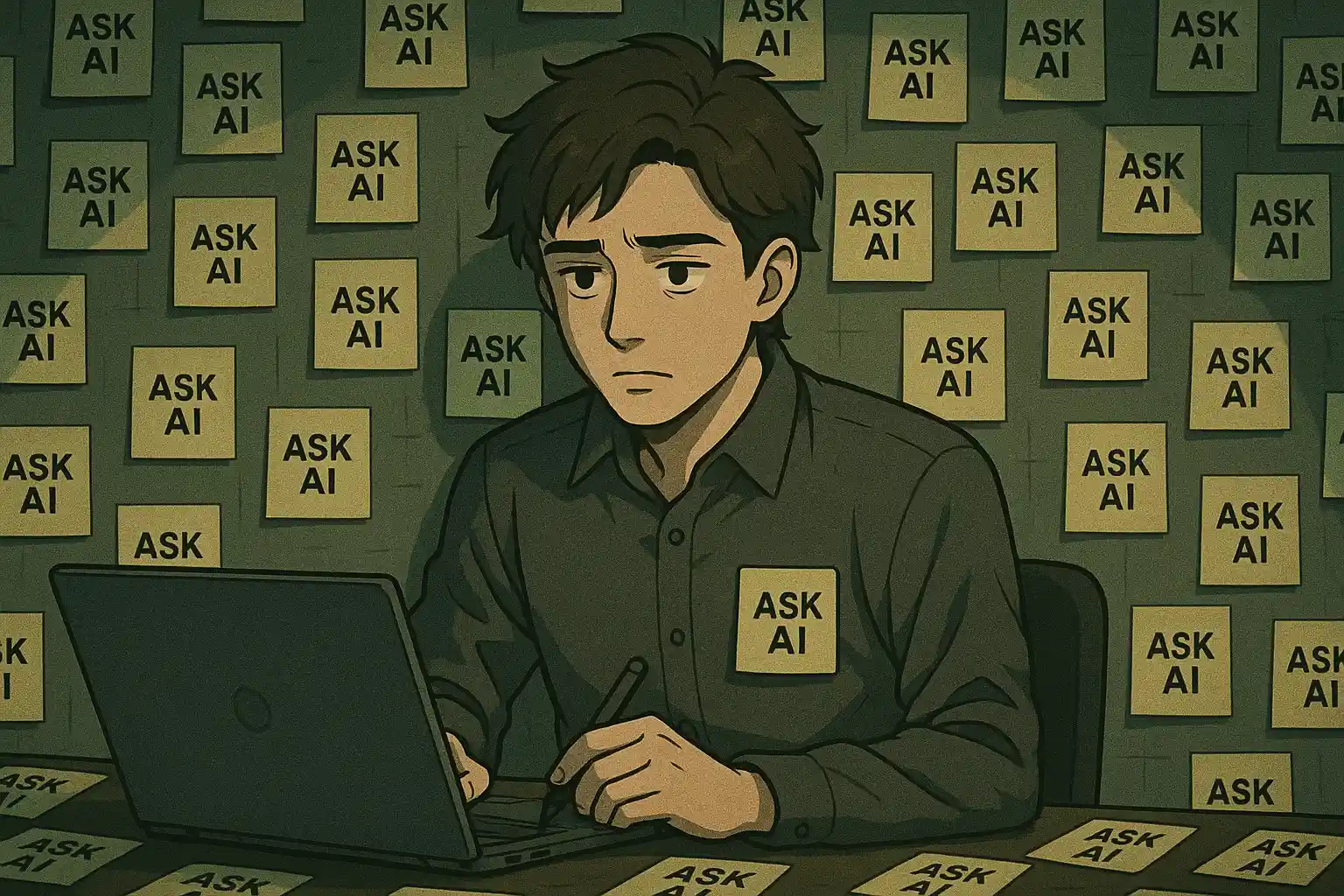
Over-reliance on AI in coding can inadvertently lead to 'learned helplessness' in developers, eroding critical thinking and deep system understanding. This post explores this phenomenon and offers strategies to reclaim essential developer skills.
AI Coding and the Rise of Learned Helplessness#
There was a time when debugging meant deep thinking. You’d sit with the error, comb through logs, step through stack traces, maybe even sketch the architecture on paper — not because it was quick, but because it was the only way to understand what was really happening.
You weren’t just writing code. You were building a mental model of the system — shaping an internal map that let you reason, predict, and adapt.
Today, that process looks different. You hit a wall, ask the machine, and get an answer. You copy, tweak, and move on. The loop is faster — but shallower. There’s less friction, and often, less thinking.
At some point, the debugging became prompting.
The reasoning became refining.
And the sense of understanding gave way to a sense of output.
The shift was subtle. But now, many developers find themselves wondering why things break, how they were fixed, or if they ever truly knew the system at all.
This is the quiet erosion AI makes easy — not because it forces you to forget, but because it makes remembering optional.
What Is Learned Helplessness — and Why Developers Should Pay Attention#
Learned helplessness is a psychological condition in which, after repeated experiences of failure or constant reliance on outside help, a person starts to believe they can’t solve problems on their own — and eventually stops trying.
In software, it rarely looks like defeat. More often, it looks like convenience.
You hit an error and ask AI. You don’t understand the output, so you ask again.
You stop debugging. You stop reasoning. You stop looking under the surface.
Over time, what began as a productivity boost becomes a pattern of dependency. You’re no longer building understanding — you’re outsourcing it, one prompt at a time.
The job stops feeling like engineering — and starts feeling like asking the right question fast enough to pass.
This is how learned helplessness takes hold — not through failure, but through the absence of friction. The more the tool helps, the less you engage. The less you engage, the more you believe you can't.
AI is supposed to assist your thinking.
But if you're not careful, it will quietly replace it.
How It Happens: The Erosion of Thought#
This isn’t about laziness. It’s about habituation — the quiet replacement of effort with convenience. It doesn’t happen all at once. It builds gradually, each time a shortcut becomes the default instead of the exception.
1. The Prompt–Fix Loop#
You write some code.
It breaks.
You ask AI.
It works.
You move on.
At first, it feels productive. But over time, the cycle becomes your workflow. There’s no pause to ask why it broke, no time spent debugging, no real post-mortem on the design. Just enough success to stay afloat — and enough repetition to normalize that drift away from depth.
2. Shallow Learning#
You stop reading documentation. Stack Overflow becomes background noise. You’re no longer comparing answers, checking vote counts, or scanning comments for traps. You just copy the first thing that seems plausible — now from AI instead of a forum.
You don’t internalize because you don’t have to. The answer will always be there when you ask again.
But what you gain in speed, you lose in memory. You’re not building knowledge — you’re leasing it, one prompt at a time.
3. Fragile Confidence#
At first, AI makes you feel fast. But eventually, you notice the hesitation — the pause before starting from scratch, the uncertainty when something doesn’t look familiar. You begin to rely on past prompts just to reorient yourself, like reading your own cheat sheet aloud.
And then the question creeps in:
Am I good at this, or just good at asking for help that sounds like I know what I’m doing?
Prompt-Dependency Spiral#
This is how it begins.
Prompt-Dependency Spiral: When repeated reliance on AI reduces a developer’s ability to think independently, leading to fragile confidence and shallow understanding.
Each shortcut feels productive. But over time, they become your primary workflow. You’re not building expertise you’re building dependence and dependence doesn’t scale it collapses under the weight of anything unfamiliar.
The Real Cost: A Tale of Two Developers#
Consider Leo and Ava.
Both are mid-level developers. Both adopted AI tools around the same time.
But only one of them is growing.
Leo#
Leo uses AI for everything — components, tests, bug fixes, you name it.
He ships quickly. His sprint updates are always green.
But six months in, the cracks begin to show.
He struggles to explain what his code actually does.
He can’t trace bugs beyond the surface.
And when a critical issue hits production, he freezes.
Leo isn’t building understanding.
He’s accumulating output.
“If you can’t explain it simply, you don’t understand it well enough.”
— attributed to Richard Feynman
It’s not that Leo lacks intelligence — it’s that he never slowed down long enough to think.
Ada#
Ada also uses AI — but as a partner, not a replacement.
She tries first, then prompts.
She uses AI to validate, not to decide.
She rewrites explanations in her own words. She logs patterns. She reflects.
Her mental model gets sharper every week.
She learns through friction, not avoidance.
When something breaks, she doesn’t have to ask the same question again —
she still remembers the answer.
By the end of the year, Leo is asking Ava for help with bugs she solved months ago — and documented, clearly, in a language he never learned to speak.
The Deeper Risk of Learned Helplessness#
This isn’t just about AI. It’s about what happens when developers lose contact with the act of thinking — when we begin to conflate speed with understanding, and output with ownership.
On the surface, it feels like progress. You’re shipping more. You’re unblocked faster. The code works. But underneath, something important is quietly eroding. You’re not solving problems anymore — you’re managing prompts. You’re not debugging — you’re just nudging the red back to green. You’re moving, but you’re not learning.
What fades isn’t just technical depth. It’s your confidence in uncertainty, your patience in complexity, your ability to trace the shape of a system in your mind. These are the muscles that make real engineering possible — and they don’t survive disuse for long.
When thinking becomes optional, it eventually becomes unavailable. And once you’ve lost the habit of reasoning through your own work, it’s incredibly difficult to rebuild.
This is the deeper risk: not that AI will replace us — but that we’ll quietly replace ourselves with something faster, flatter, and less curious.
1. Your Mental Models Collapse#
Without constructing the logic yourself, you stop seeing the system.
You lose the ability to reason about flow, side effects, edge cases.
You didn’t build the architecture — you assembled it from parts you don’t own.
2. Your Confidence Becomes Dependent#
AI may feel like a superpower at first. But with enough use, it turns into a dependency.
You hesitate to take on unfamiliar tasks. You wait until you’ve seen something similar in a prompt.
Soon, you stop trusting your ability to figure things out without it.
3. You Become Hard to Promote#
Mentorship, debugging, architecture decisions — they all require internal clarity.
You can’t lead if you can’t explain.
You can’t grow if you don’t understand the why behind your own code.
AI can help you build. But it won’t help you lead.
4. Burnout Through Disconnection#
You’re shipping more, but feeling less.
There’s no insight, no ownership — just output masquerading as progress.
This is the quiet kind of burnout. Not from stress, but from detachment.
You lose the sense that you’re building something meaningful — because you’re no longer building it.
How to Reclaim Your Thinking#
AI isn’t going away — and it shouldn’t. But if you want to stay sharp, thoughtful, and promotable in a world full of shortcuts, you’ll need to build habits that protect your mind from atrophy.
Here are six practices to bring your thinking back online.
1. Think Before You Prompt#
Look at the error. Sketch a flow. Take a breath. Try.
Even if you’re wrong, especially if you’re wrong — that pause builds the problem-solving muscle AI wants to replace.
Yes, it’s uncomfortable. Yes, your brain will itch for the easy answer.
But that discomfort? That’s the cost of learning something that stays with you. It is the tuition you pay for lasting understanding.
You’re not supposed to feel smart all the time.
You’re supposed to feel engaged — even when it stings.
No thought? No skill.
No friction? No growth.
2. Explain It Back#
Got a working solution from AI? Great. Now teach it to yourself.
Write a comment explaining:
- What the code does — step-by-step logic
- What it’s meant to achieve — the intent behind it
Bonus points if you draw a quick diagram or annotate with edge cases.
If you can’t explain both, you don’t understand it.
And if you don’t understand it, it’s only a matter of time before it breaks — and takes you with it.
Make the code legible to your future self.
That version of you won’t remember the prompt — but they’ll have to live with the consequences.
3. Schedule No-AI Sessions#
Code with the lights off. No Copilot. No autocomplete. No instant linting.
Just you, your editor, and your brain.
One hour a week is enough to notice two things:
- How much you still know
- How often you’ve stopped using it
When I’m learning a new programming language, I disable every extension — no formatter, no autocomplete, no syntax hints.
It’s like learning to type: if you rely on the training wheels too long, your fingers never learn the patterns.
This is no different.
If you want fluency, you have to feel your way through the syntax — not have it filled in for you.
4. Rotate Between AI and Reality#
AI is an incredible interpreter. But it is not the source.
Alternate between days when you use AI and days when you go straight to the well — the docs, the RFCs, the changelogs, the original GitHub issues.
It’s slower. It’s messier. But it’s real.
And the deeper your direct knowledge, the less brittle your thinking becomes.
Don’t let your understanding be secondhand.
Master the source material — not just the summaries.
Because when the tools glitch, hallucinate, or disappear, what’s left isn’t what you prompted.
It’s what you actually know.
5. Keep a Developer Journal#
Every time you solve something, write down:
- What was broken
- What fixed it
- What you learned
It doesn’t have to be elegant — just consistent.
Think of it as your personal debugging log — something your future self can search.
6. Pair With Yourself#
Talk to yourself like a staff engineer reviewing your own pull request.
Ask:
- What assumptions am I making?
- Where does this break?
- Would this still make sense to me in six months?
This isn’t about perfection — it’s about practicing clarity.
That internal dialogue is what separates coders from architects.
It’s how you move from just writing code to owning decisions.
If you want to lead, start by reviewing your own thinking — before anyone else does.
Closing#
This isn’t an argument against AI. It’s an argument for preserving the parts of you that make software worth building in the first place.
This is not a rejection of progress. It’s a defense of depth.
The industry will keep accelerating. Tools will get smarter. Prompts will get sharper. But if you're not careful, your ability to think clearly, debug patiently, and build systems with real understanding will quietly erode. Not because you’re incapable—but because you stopped practicing.
What makes a great developer isn’t how quickly they can generate working code. It’s how deeply they understand what they’re building. It’s the instinct to ask why something works, not just how to make it work. That instinct doesn’t come from shortcuts. It comes from struggle, reflection, and ownership.
AI can help you move fast.
But growth has never been about speed.
It's about depth.
About staying with the question.
About remembering the system you built inside your head — not just the one inside your editor.
Tools don’t make you better — just faster at being who you already are.
Daniel Philip Johnson
The developers who thrive in the AI era won’t be the ones who automate the most.
They’ll be the ones who still know how to think when the tools fall silent.
“AI won’t replace you — but it might forget to remind you who you are.”